
We cannot start to solve your specific problem until we first gain a solid understanding of the problem. In our initial contact we strive to understand:
Specific needs and background
Origins of the problem
Scope of the investigation
Key issues to be examined
Consulting Methodology

Once gathered, the above information helps the client decide whether we are the best people to handle the assignment. It also helps us determine if we can do the job and whether we can do it properly in the time available.
When appropriate, the details and results of this discussion are confirmed in a written proposal outlining:
Our understanding of the assignment
Suggested approach
Type and extent of client involvement
Organization of the work
Expected results
Estimated time and cost
During each assignment, periodic updates are given. These are augmented by at least one interim review to summarize our findings to date and discuss any modifications in the direction for the balance of the project. Upon completion of the assignment, we report our findings and recommendations to client management, normally in the form of a briefing presentation.
While structured, this presentation encourages the questioning and discussion of our findings. Our goal is to provide clients with recommendations which are practical for them to implement. The presentation is then documented with a written report.
At this time we determine:
A broad definition of the assignment and expected results
The information gathering methodology
Logical phases if (practical)
Approximate time and cost
CONTRACTUAL TERMS & CONDITIONS
Fees are based on the time needed plus expenses actually incurred in carrying out the assignment. Professional time of QBuilt will be billed as either a fixed fee (if the required result can be precisely defined) or at an hourly rate quoted upon agreement of the scope of the assignment.
In addition, the client will reimburse all expenses, plus a 20% handling charge added to these expenses. These expenses will be estimated upon agreement of the project’s scope. If the actual expenses exceed the agreed estimate, the client will reimburse such excess expenses, but will not be charged any further handling charge on the additional amount.
Expenses include all out of pocket costs such as travel, lodging, telephone, printing and copying, postage, user fees for on-line information retrieval, publications, independent contractor assistance, and similar items. Other costs such as word processing and mileage will be treated as expenses at rates approximating local commercial charges. Detailed expense records are maintained in our office and may be inspected if desired.
If travel costs are incurred on a trip that serves two or more clients, common travel costs will be allocated to each client in proportion to costs that would have been incurred for travel dedicated solely to each client alone.
Bills will be submitted twice a month, normally on the first and fifteenth. Bills are due and payable when submitted. A late payment charge of 1.5% per month (18.00% annually) may be applied to amounts outstanding ten (10) days after the date of the statement.
The client always has the right to terminate the assignment upon written notice. In such a case the client has no liability for charges beyond those incurred on their behalf through the date when notice of termination is received by us. Because we cannot serve a client under terms or conditions that might impair our objectivity, independence, or integrity, QBuilt reserves the right to withdraw from the assignment if conditions develop to interfere with the successful completion of the assignment.
It is understood that QBuilt and its contractors, if any, shall be in the relation of independent contractors with the client, and nothing herein shall be construed as designating us as employees or agents of the client for any purpose. QBuilt will guard as confidential all information concerning the affairs of the client that is gathered during the course of the assignment. We agree to hold such information in strict confidence, and not to disclose it to others for a period of five years or until such information is otherwise released by the client. QBuilt will not serve two or more competing clients in areas of vital interest without first informing each client.
The rights to any inventions that result from our work will be assigned to the client without any further charge for professional time. The client is responsible for all legal fees and similar expenses necessary to obtain patents that the client may desire to register.
CONSULTING PRINCIPLES
We know that we are being hired for independent judgment and objectivity, technical expertise, analytical skill and concentrated attention to the solution of a problem. We will provide those skills. We will be impartial. We will guard the confidentiality of all client information.
We will not take financial gain or any other kind of advantage based on inside information. We will not serve two or more competing clients on sensitive problems without obtaining the approval of each client to do so. We will inform the client of any circumstances, which might influence our judgment or objectivity.
Before accepting an assignment, we will confer with the client in sufficient detail to understand the problem and the scope of study needed to solve it. Such preliminary consultations are conducted confidentially, on terms agreed to by the client.
We will only accept those assignments we are qualified to perform which will provide real benefit to the client; we cannot guarantee any specific results, such as the amount of cost reduction or profit increase. We present our qualifications on the basis of competence and experience. We perform each assignment on an individualized basis, and develop recommendations specifically for the practical solution of each client’s problem.
"We perform each assignment on an individualized basis, and develop recommendations specifically for the practical solution of each client's problem."
CUSTOMER RELATIONSHIP
Satisfied customers are key to our success. QBuilt will attain total customer satisfaction by understanding what the customer wants and delivering it efficiently. Work is either carried out on a retainer basis for a stipulated period, or more commonly, as a single project assignment. Whenever feasible, we agree with the client in advance on the fee basis for an assignment. We do not accept commissions or pay them to others for client referrals. We do not also accept fees or commissions from others for recommending equipment, supplies, or services to their clients, as this would affect our impartiality.
QUALITY MANAGEMENT in CONSTRUCTION

Quality management in construction is a dynamic process covering the total enterprise, embracing all aspects of operations (product/project development, manufacturing/construction, organization and human resources, customer support) including customer-supplier networks, which is governed by a systemic set of principles, methods and practices. Key quality management principles are perfect first-time quality, waste minimization by removing all activities that do not add value, continuous improvement, flexibility, and long-term relationships.
QBuilt’s quality management model stresses an evolutionary process of change and adaptation, not an idealized technology-driven end state. A central organizing concept in our model is the sustainable enterprise, where the organization builds mutual-gain processes and relationships with its multiple stakeholders.
Chief benefits of our quality management model include efficient use of resources, rapid product / project development cycle, higher quality at lower cost, greater flexibility, and environmentally sustainable operations.
QBuilt LLC developed this program to provide an awareness of what world-class organizations are doing to achieve operational excellence and competitive advantage. This program is also designed to gain your personal commitment to improving the competitive position of your organization. Practices that commonly lead to operational excellence and competitive advantage embody the philosophy and decision-making criteria that underlie all successful LMC efforts. Organizations and companies adopting LMC practices have become serious competitors on the world scene. They are fully capable of, and intent upon, beating their opponents and completely changing the way business is done in any industry they enter.
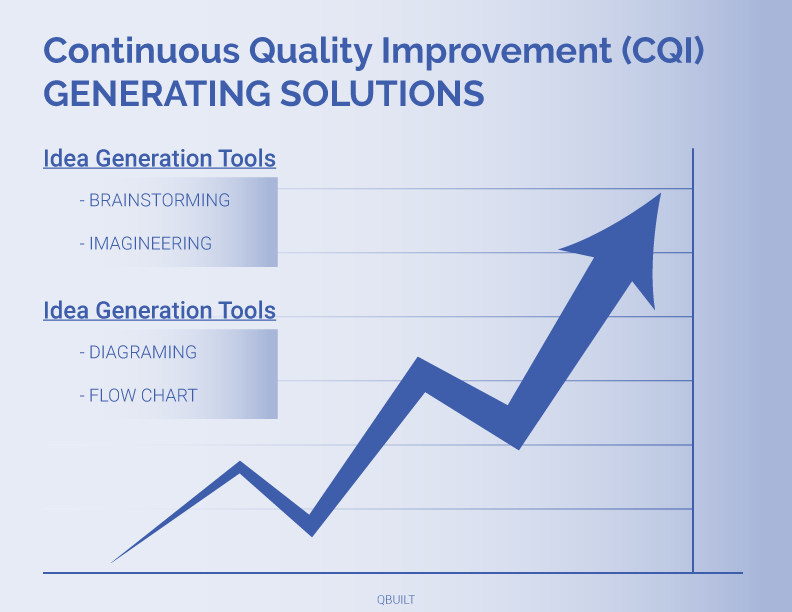
Continuous Quality Improvement (CQI) starts with idea generation and then assessing those ideas with diagrams and flowcharts to elevate our value.
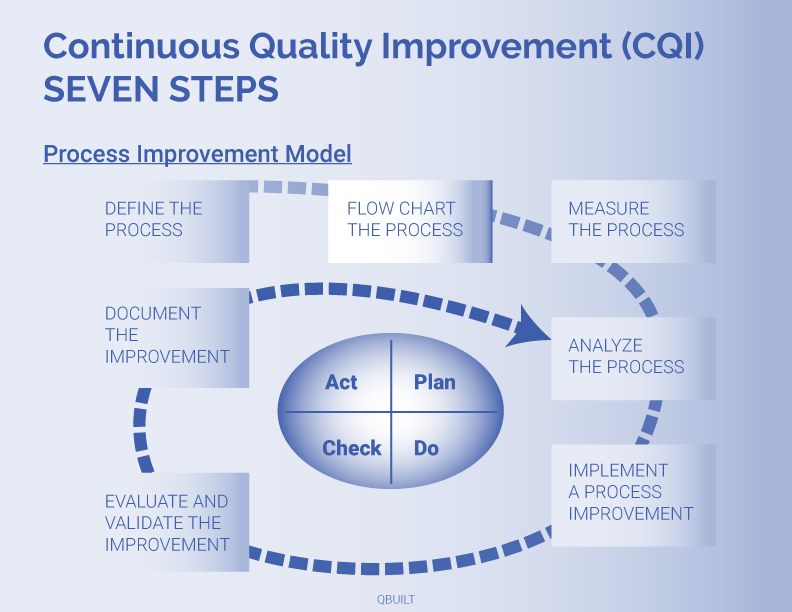
The seven steps used in CQI:
1) Define the process
2) Flowchart the process
3) Measure the process
4) Analyze the process
5) Implement a process improvement
6) Evaluate and validate the improvement
7) Document the improvement